
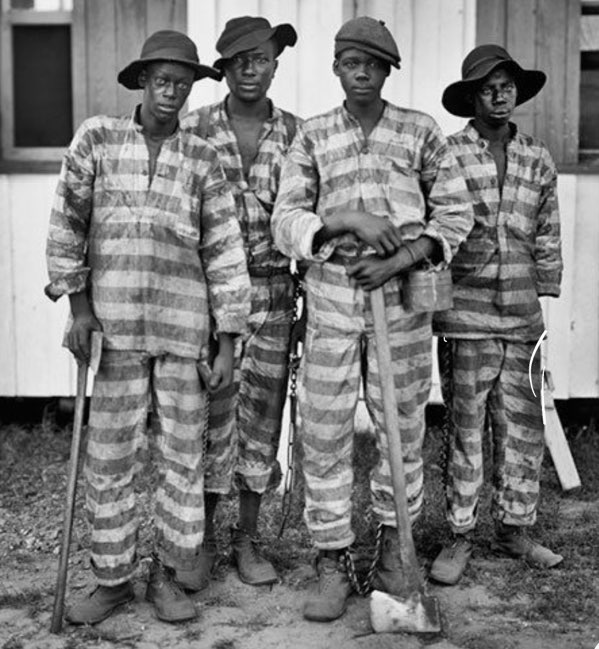
I was told the guy third from the left looks a lot like my Great Uncle Robert. Grandma almost never talked about him but he’s the reason she and her two sisters came north. Slavery may have ended but the conditions in the south got continually worse after the Civil War. By the turn of the century, what had been Plantation Law was now the Law of the Land. There was the Constitution, Jim Crow, and the Black Codes, all separate and not equal.
Whippings, rape and murder were always plantation practices. Now there were no “owners” but the practices and, most importantly, the rules had only slightly changed and not for the better. You weren’t owned but you weren’t free. You sharecropped, barely fed your family and got nowhere. Even if you died, the family was responsible for your debt and debt was just another name for slavery.
Being in prison was worse than being on a plantation. In prison, you were locked in a cage and only allowed out to work. There was no male/female interaction. You worked until you died or they killed you. There are few records on how many men survived a southern prison sentence. Any infraction could get you killed and almost no one cared. You were a criminal with no rights. You labored everyday. It wasn’t slave labor. It was Convict Labor, the new term to cover this new status. Master was now Warden.
So the bits and pieces suggest Great Uncle Bob was arrested as a vagrant even though he worked harder than most. It was Sunday and he was on his way to see how mom and his sisters were getting on now that he worked six days a week in town as a blacksmith’s helper mostly mucking out the town stable. He generally slept in the barn so he’d be there, working, at dawn. He was accosted, by “patrollers”, arrested and sentenced to 6 months hard labor. Three months later great grandma heard he was dead. Upon hearing her hopes and first born were gone with no inkling how he was killed or even if he had been buried she died. She was sure he had been killed. She always felt he was the type of man that would be murdered.
So his sisters knew it was time to leave Maryland. There was nothing to keep the in the south. That was Spring 1900. Two of Great Uncle Robert’s sisters wound up on Long Island and Cornelia, my grandmother, the youngest girl, that could pass if she wanted to, landed in Harlem. A story for another day.
 Fried Chicken & Philosophy